
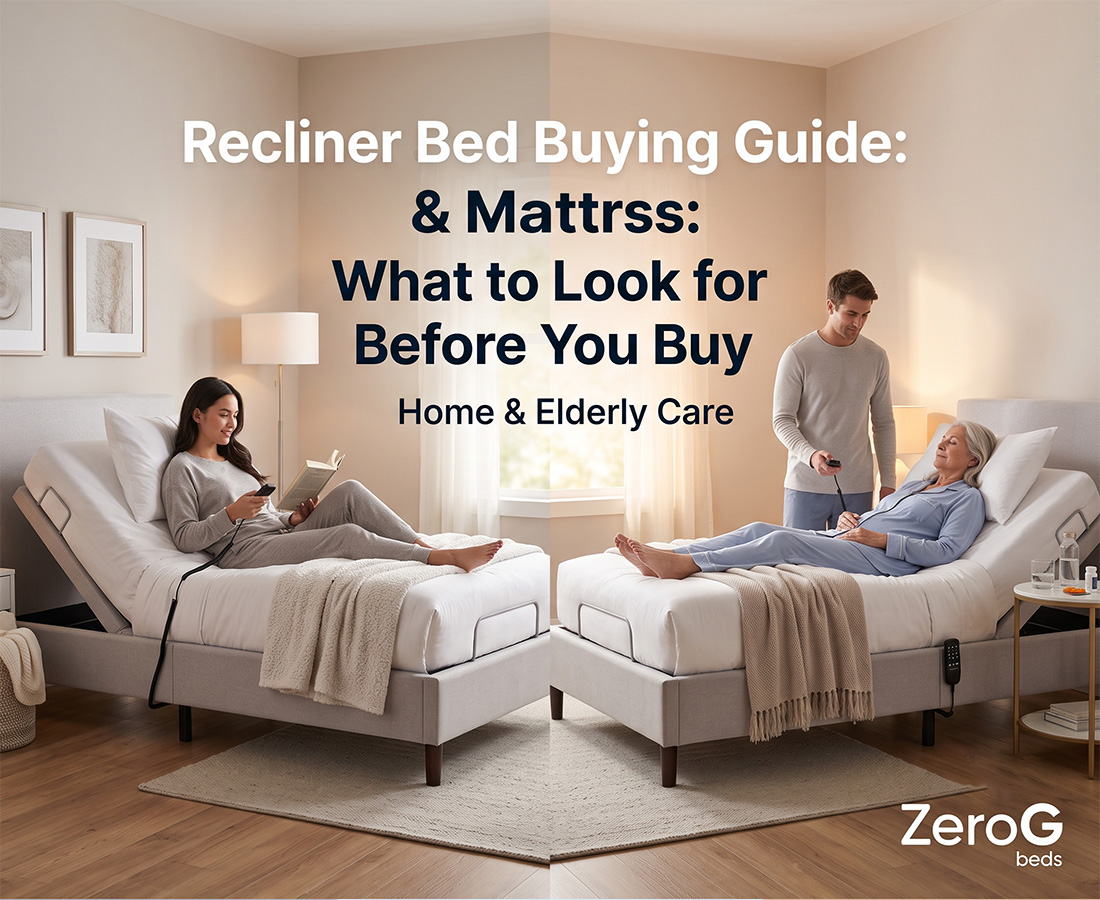
What Is a Recliner Bed and How Does It Work?
A recliner bed is a bed base that adjusts its position — typically raising the head section, the foot section, or both — to create customized angles for sleeping, resting, or recovery. Unlike a standard flat bed, it allows you to sit partially upright, elevate your legs, or find a "zero gravity" position that distributes body weight more evenly.
The key difference between a recliner bed and a standard bed? Flexibility. A recliner bed moves with you rather than keeping you fixed in one position all night. The Zero-G Recliner Bed is a great example — designed for both comfort-focused home users and those with care or mobility needs.
Manual vs Electric Recliner Beds

For most people — especially those buying an electric recliner bed for elderly care — the electric option wins. The convenience of a remote control and quiet motor makes a genuine difference when mobility is limited or when a caregiver is assisting. For younger users who only want occasional position changes, a manual option may suffice.
Key Benefits for Elderly Care & Medical Recovery
A recliner bed for elderly users isn't a luxury — in many cases, it's a genuine care necessity. Here's why:
- Improved circulation: Elevating the legs reduces swelling and supports blood flow, particularly important for those with limited mobility
Recliner Bed vs Adjustable Bed: What's the Difference?
Honestly? In most retail contexts — including on the Zero-G website — the terms recliner bed and adjustable bed are often used interchangeably. Both refer to bases that change position electronically or manually.
The subtle distinction: "recliner bed" tends to emphasize full-body or seated-position comfort (think: recliner chair functionality in bed form), while "adjustable bed" is a broader term that can include medical-grade hospital-style frames. For home and elderly care use, they refer to the same category of product.
Recliner Bed Buying Checklist
Before you finalize your purchase, run through this:
- ✅ Identified your primary use (home comfort vs elderly/medical care)
- ✅ Chosen between manual and electric (electric recommended for elderly)
- ✅ Confirmed mattress compatibility (foam or hybrid)
- ✅ Checked weight capacity against user requirements
- ✅ Verified available sizes match your room/frame
- ✅ Checked safety features if buying for an elderly or mobility-limited user
- ✅ Reviewed the Zero-G Recliner Bed options and mattress pairing choices
FAQs
What is the difference between a recliner bed and an adjustable bed? In most cases, the terms overlap and refer to the same product type — a bed base that adjusts head and/or foot position. On the Zero-G site, the recliner bed combines home comfort and care-focused adjustability in one frame. The terminology difference is mostly marketing, not function.
Are recliner beds good for elderly people? Yes — they support circulation, reduce pressure sore risk, and make caregiver assistance much easier. An electric recliner bed for elderly users is particularly beneficial due to remote-controlled ease. Always consult a medical professional for specific post-surgery or health-related positioning needs.
Is an electric recliner bed worth the extra cost over manual? For daily users and elderly care, absolutely. The precision, ease of one-touch adjustment, and reduced physical effort make electric significantly more practical. Manual options suit occasional users or those on tighter budgets who don't need frequent position changes.
Reduced pressure sores: Adjusting position throughout the day or night relieves sustained pressure
on vulnerable areas
Caregiver assistance: Raising a patient to a partial sitting position makes transfers, dressing,
and feeding significantly easier
Post surgery recovery: An adjustable recliner bed allows recovery at precise angles recommended after procedures — without needing extra pillows or props
The Zero-G Recliner Bed supports all of these needs with smooth, whisper-quiet electric adjustment.
Key Benefits for Everyday Home Use
Not buying for care? A recliner bed for home still delivers real value:
- Comfort while reading or watching TV — no more stacking pillows against a headboard
- Reduced acid reflux and snoring — slight head elevation makes a measurable difference for both
- Back support — maintaining a supported angle reduces morning stiffness and lower back tension
- The "zero gravity" position — elevating both head and legs simultaneously takes pressure off the spine, improving sleep quality
If you spend any meaningful time in bed beyond sleeping, an electric recliner bed upgrades the entire experience.
Features to Look For
Before committing, run through these essentials:
- Adjustable zones: Head-only? Foot-only? Both independently? More zones = more flexibility
- Remote control quality: Backlit, simple buttons, and ideally wireless for elderly users
- Motor noise: A quiet motor matters — especially at night or in shared rooms
- Weight capacity: Always check the manufacturer's stated limit before buying
- Mattress compatibility: Foam and hybrid mattresses work best on adjustable bases — more on this below
- Safety features for elderly users: Look for emergency lowering functions, anti-trap sensors, and optional bed rails
The Zero-G Recliner Bed ticks these boxes and comes in multiple size options to suit different room configurations.
Can I use a regular mattress on a recliner bed? Not always. Rigid innerspring mattresses don't flex well on adjustable bases and can be damaged over time. Foam, memory foam, or hybrid mattresses are the best match — and the Zero-G Recliner Bed allows you to select a compatible mattress directly at checkout.
How much weight can a recliner bed support? Weight capacity varies by model and should always be verified before purchasing. Check the manufacturer's specifications carefully — especially if the bed will be used by larger individuals or if a caregiver will be assisting from the side of the frame.